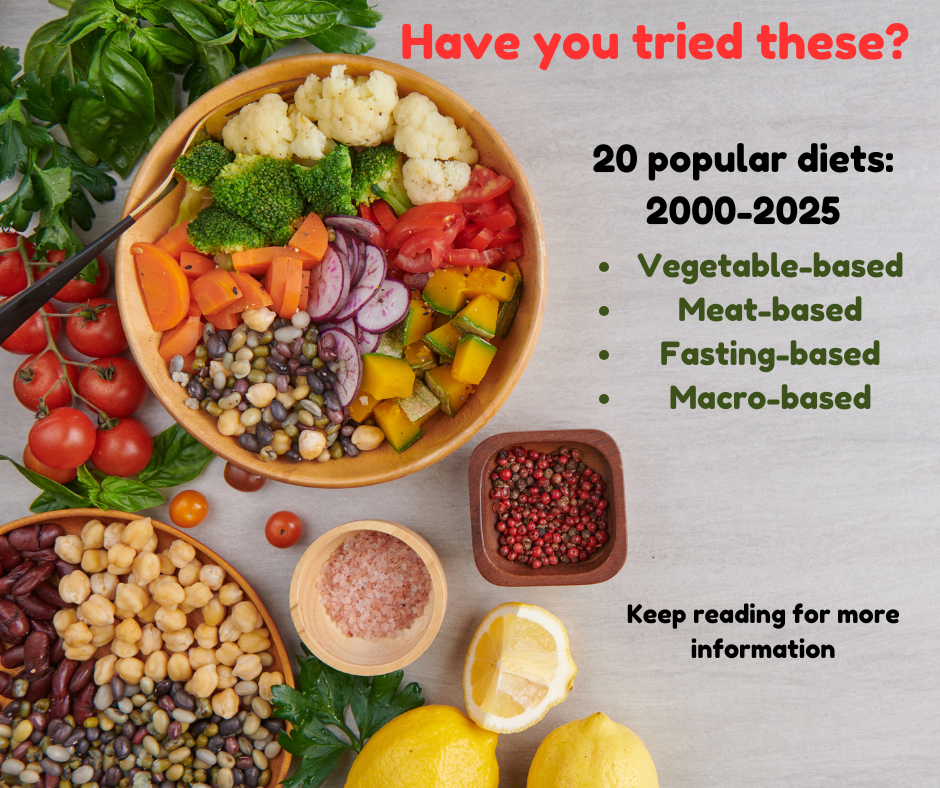
Fad diets come and go, but after a few decades I’ve noticed that there is a trend among diets. Some may be vegetable-based, others meat-based, but they mostly agree on a balance of protein, water, and an array of nutrients while minimizing sugars and highly-processed carbohydrates.
In the spirit of it being spring, when many people (including me!) are trying to lose the winter weight, I started reading about the most popular diets right now. That led me to question, what happened to the food program I did 25 years ago? It worked great, why did it fizzle out?
Through my research, it became apparent that it didn’t fizzle out, it’s just been modified slightly and rebranded.
Below is a concise list of pros and cons for each of the 20 popular diet trends since the year 2000, along with select sources. Because many of these diets overlap in principles or have similar critiques, certain references apply to more than one diet. Always consult a qualified healthcare professional or registered dietitian before making major dietary changes.
1. Atkins Diet (Resurgence in Early 2000s)
Pros
- Rapid Weight Loss: Initial carbohydrate restriction can lead to fast water and fat loss (1).
- Simple Guidelines: Straightforward instruction to limit carbs and emphasize proteins/fats.
Cons
- High Saturated Fat Intake: Potential long-term cardiovascular risk if not carefully managed (2).
- Difficult to Sustain: Strict carb limits can be challenging over the long term.
2. South Beach Diet (Mid-2000s)
Pros
- Balanced Phases: Gradual reintroduction of healthy carbs fosters more sustainable habits (3).
- Heart-Healthy Focus: Limits saturated fats; emphasizes lean protein and “good carbs.”
Cons
- Strict First Phase: Eliminates nearly all carbs, including fruit, which can be hard initially.
- Phased Complexity: Some find the tracking of allowable foods in each phase cumbersome.
3. The Zone Diet (Ongoing Popularity)
Pros
- Macronutrient Balance: Focus on 40% carbs, 30% protein, 30% fat can help stabilize blood sugar (4).
- Portion Control: Encourages awareness of portion sizes.
Cons
- Strict Ratios: Requires vigilance in measuring food portions and hitting precise macronutrient percentages.
- Limited Evidence: Mixed scientific support for the exact 40/30/30 ratio’s superiority.
4. Paleolithic (Paleo) Diet (Late 2000s–Early 2010s)
Pros
- Whole Foods Emphasis: Minimally processed, nutrient-rich foods (5).
- Reduced Sugar and Processed Foods: Often leads to weight loss and improved blood markers in the short term.
Cons
- Excludes Healthy Food Groups: No grains, legumes, or most dairy—nutrient gaps can arise.
- Cost and Accessibility: High reliance on quality meats and produce may be expensive.
5. Gluten-Free Diet (2000s Surge)
Pros
- Crucial for Celiac/Gluten Sensitivity: Can resolve digestive and autoimmune symptoms (6).
- Encourages Label Reading: Heightened awareness of food ingredients.
Cons
- Unnecessary for Many: Restrictive without medical need; gluten-free packaged foods can be heavily processed.
- Risk of Nutrient Deficiencies: Many gluten-free products lack fiber, vitamins, and minerals.
6. Intermittent Fasting (2010s Boom)
Pros
- Flexible Timing: Multiple methods (16:8, 5:2, alternate-day) to fit different lifestyles.
- Potential Metabolic Benefits: Some evidence of improved insulin sensitivity and weight management (7).
Cons
- Hunger and Compliance: Fasting windows can be difficult for some individuals.
- Not a Traditional “Diet”: Doesn’t inherently dictate food quality; requires balanced choices within eating windows.

7. The Master Cleanse / Detox Diets
Pros
- Short-Term Weight Loss: Extremely low-calorie regimens usually produce quick (but often temporary) results.
- Focus on Reducing Processed Foods: Some detox protocols encourage removing sugary, highly processed foods.
Cons
- Nutritional Deficiency: Often lacks essential nutrients (protein, fiber, healthy fats).
- Rapid Rebound: Weight is usually regained once normal eating resumes.
8. Raw Food Diet
Pros
- High in Fruits and Vegetables: Can increase intake of antioxidants, fiber, and vitamins (8).
- Minimal Processed Foods: Avoids additives, preservatives, and refined sugars.
Cons
- Potential Nutrient Gaps: Excludes many cooked legumes, grains, and often animal products; careful planning is essential.
- Difficult Long-Term: Socially and practically challenging; certain beneficial nutrients (lycopene in tomatoes) are more bioavailable when cooked.
9. Dukan Diet (Peaked Early 2010s)
Pros
- High Protein: Can help with satiety and muscle retention.
- Structured Phases: Provides a clear roadmap for dieters.
Cons
- Very Restrictive: Limits carbs drastically, especially in early phases.
- Possible Kidney Strain: High protein intakes may not be suitable for individuals with kidney issues (9).
10. Alkaline Diet (2010s Trend)
Pros
- Emphasis on Whole Plant Foods: Encourages fruit, vegetables, nuts, and seeds—generally healthful.
- Reduced Processed Foods: Limits processed meats, refined grains, sugars.
Cons
- Unproven pH Claims: Human blood pH is tightly regulated, and diet has minimal impact on systemic pH (10).
- Overly Restrictive: Cutting out entire categories of foods can create nutrient gaps.
11. Ketogenic (Keto) Diet (Resurgence Mid-2010s)
Pros
- Rapid Weight Loss: Often from reduced carb intake and water loss (11).
- Stabilized Blood Sugar: Can benefit insulin-resistant individuals when supervised.
Cons
- Strict Carb Limit: Challenging to maintain; “keto flu” during adaptation.
- Nutrient Deficiencies: Potential lack of fiber, vitamins, and minerals if not carefully planned.
12. Whole30 (Late 2000s–2010s)
Pros
- Elimination of Processed Foods: Emphasizes whole, nutrient-dense options.
- Identification of Food Sensitivities: Eliminates common allergens (grains, dairy, legumes) temporarily.
Cons
- Short-Term Restriction: High dropout rate; reintroduction phase isn’t always followed effectively.
- Not Intended as a Long-Term Diet: Can be too rigid for sustainable everyday eating.
13. IIFYM (If It Fits Your Macros) / Flexible Dieting (2010s)
Pros
- Flexibility: Allows any food as long as macro targets (protein, carbs, fat) are met.
- Less Food Guilt: Fewer “forbidden” foods, can improve adherence for some.
Cons
- Quality vs. Quantity: Risk of ignoring micronutrients, fiber, and overall diet quality.
- Requires Tracking: Must closely monitor macros—time-consuming for some.
14. Carnivore Diet (Late 2010s)
Pros
- Extremely Low Carb: May aid weight loss in carb-sensitive individuals.
- Simple Rules: Eat only animal-based foods, minimal meal planning.
Cons
- Nutrient Deficiencies: Lack of fiber, vitamins C and E, and phytochemicals from plants (12).
- Long-Term Health Unclear: Few scientific studies on prolonged adherence.

15. Flexitarian Diet (2010s Growth)
Pros
- Mostly Plant-Based: Reduces intake of red meat and processed products.
- Less Restrictive: Allows occasional meat/animal products, easier social adaptation.
Cons
- Vague Guidelines: No strict blueprint; “flexibility” can lead to inconsistencies in nutritional intake.
- Relies on Personal Discipline: Results vary widely based on individual choices.
16. Vegan Diet (Significant Surge in 2010s)
Pros
- Ethical & Environmental: Avoids animal products; may reduce carbon footprint (13).
- High in Fiber & Antioxidants: Linked with lower risk of certain chronic diseases (14).
Cons
- Nutrient Gaps: Must supplement or carefully plan for vitamin B12, iron, omega-3s, calcium.
- Social Challenges: Eating out and special occasions can require extra planning.
17. MIND Diet (Mid-2010s)
Pros
- Research-Backed: Combines Mediterranean & DASH diets with evidence of potential cognitive benefits (15).
- Flexible and Balanced: Emphasizes whole grains, leafy greens, berries, beans, nuts, fish, poultry, olive oil.
Cons
- Not as “Trendy”: Less immediate weight-loss focus; some may find it less motivating for rapid results.
- No Strict Rules: May be too general for dieters wanting rigid structure.
18. Mediterranean Diet (Ongoing Recognition)
Pros
- Well-Studied: Consistently associated with better heart health, longevity, and reduced disease risk (16).
- Balanced, Enjoyable Foods: Promotes fruits, vegetables, whole grains, fish, olive oil, limited sweets.
Cons
- Cultural Variance: May be costly or less accessible outside Mediterranean-like regions.
- Weight Loss Rate: Typically slower, though more sustainable long-term.
19. Anti-Inflammatory Diet (2000s–Present)
Pros
- Emphasis on Whole Foods: High in omega-3 fats, antioxidants, fruits, vegetables.
- Potential Health Benefits: May help reduce markers of chronic inflammation (17).
Cons
- Broad Definition: No single, standardized plan; can be confusing for new adopters.
- Supplement Claims: Some “anti-inflammatory” products or supplements may be marketed with limited evidence.
20. Sirtfood Diet (Mid-2010s)
Pros
- Inclusion of Nutrient-Dense Foods: Encourages berries, green tea, kale, turmeric, etc.
- Initial Enthusiasm: Celebrity endorsements and social media hype.
Cons
- Limited Research: Evidence for “activating sirtuins” to promote weight loss or anti-aging is still emerging (18).
- Restrictive Phases: Early low-calorie phase can be difficult to follow.
So, you are probably wondering, which one did I find success on? The South Beach Diet! It makes sense to me, effective and achievable without being overly restrictive. For me, it is effective since it kickstarts the early weight management with high-protein then gradually adds in high-quality grains and vegetable diets. The first couple of weeks are tough, but let’s be real, my body needs a kick in the pants.
Here’s the real thing: it makes sense for my lifestyle and is something I can use as a good everyday guideline when I need to lose a few.
The real trick: Do what makes sense to you. It may not be a diet at all, but instead a simple lifestyle. The one that works for you is the only one that works!
References
- Westman EC, Yancy WS Jr, Edman JS, et al. (2002). The effect of a low-carbohydrate, ketogenic diet versus a low-glycemic index diet on glycemic control in type 2 diabetes mellitus. Nutrition & Metabolism, 2, 34.
- Hu FB, Willett WC. (2002). Optimal diets for prevention of coronary heart disease. JAMA, 288(20), 2569-2578.
- Agatston A. (2003). The South Beach Diet. Rodale.
- Sears B. (1995). The Zone: A Dietary Road Map. ReganBooks.
- Cordain L. (2010). The Paleo Diet. Wiley.
- Fasano A. (2005). Clinical presentation of celiac disease in the pediatric population. Gastroenterology, 128(4 Suppl 1), S68-S73.
- Patterson RE, Laughlin GA, Sears DD, et al. (2015). Intermittent Fasting and Human Metabolic Health. J Acad Nutr Diet, 115(8), 1203-1212.
- Kahlon TS, Chiu MM. (2015). A Review of the Effect of Food Processing and Preparation Methods on the Nutritional Composition and Bioactive Components of Vegetables. Crit Rev Food Sci Nutr, 55(8), 1091-1107.
- Martin WF, Armstrong LE, Rodriguez NR. (2005). Dietary protein intake and renal function. Nutrition & Metabolism, 2, 25.
- Schwalfenberg GK. (2012). The alkaline diet: is there evidence that an alkaline pH diet benefits health? J Environ Public Health, 2012, 727630.
- Paoli A. (2014). Ketogenic diet for obesity: friend or foe? Int J Environ Res Public Health, 11(2), 2092-2107.
- DiNicolantonio JJ, O’Keefe JH. (2018). Added sugars drive nutrient and energy deficit in obesity, metabolic syndrome, and type 2 diabetes. Open Heart, 5(2), e000617. (Cites dietary patterns lacking in micronutrients.)
- Scarborough P, Appleby PN, Mizdrak A, et al. (2014). Dietary greenhouse gas emissions of meat-eaters, fish-eaters, vegetarians and vegans in the UK. Climatic Change, 125, 179–192.
- Craig WJ. (2009). Health effects of vegan diets. Am J Clin Nutr, 89(5), 1627S-1633S.
- Morris MC, Tangney CC, Wang Y, et al. (2015). MIND diet associated with reduced incidence of Alzheimer’s disease. Alzheimers Dement, 11(9), 1007-1014.
- Estruch R, Ros E, Salas-Salvadó J, et al. (2013). Primary prevention of cardiovascular disease with a Mediterranean diet. N Engl J Med, 368(14), 1279-1290.
- Calder PC. (2017). Omega-3 Fatty Acids and Inflammatory Processes. Nutrients, 9(5), 459.
- Houtkooper RH, Pirinen E, Auwerx J. (2012). Sirtuins as regulators of metabolism and healthspan. Nat Rev Mol Cell Biol, 13(4), 225-238.
Disclaimer: This information is for general educational purposes. Individual results vary, and each diet may have contraindications for certain health conditions. Always consult a healthcare professional or registered dietitian for personalized guidance.